
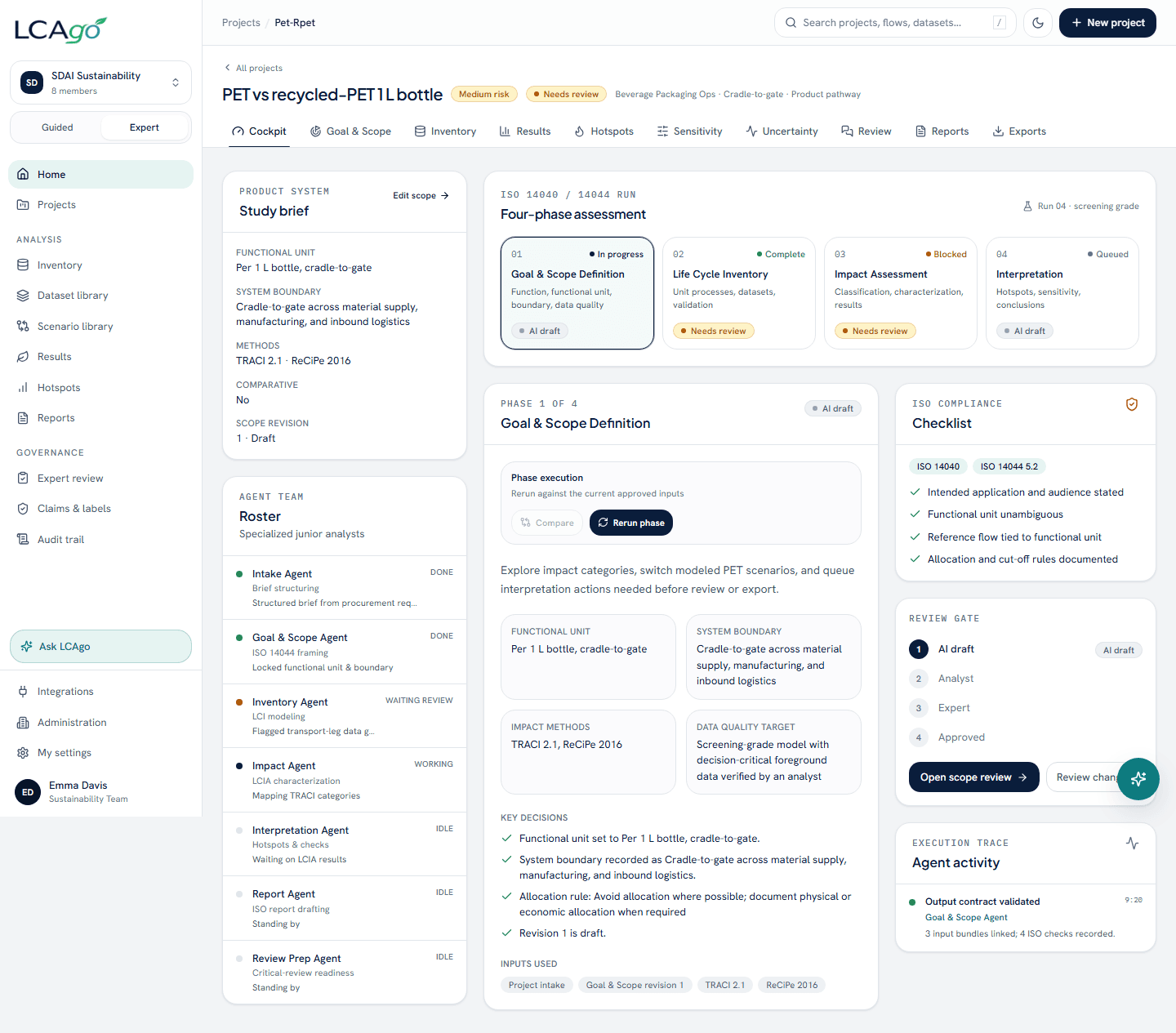
Guided assessment dashboard
Study scope, inventory status, impact results, and review tasks in one view.

An agentic environment for life cycle assessment.
Human in the loopConfigurable agentsTraceable methodsExpert reviewed
Overview
LCAgo coordinates data, models, methods, and review across established LCA software in one collaborative workspace.
LCAgo helps researchers and sustainability teams build, assess, and interpret life cycle assessments with AI assistance and expert-guided workflows. It orchestrates openLCA, Brightway2, Python workflows, and internal data while keeping evidence, assumptions, methods, and results inspectable.LCAgo structures that work as a versioned and auditable workflows. Automate with AI, human-in-the-loop collaboration, and expert review.
Inside the workspace
From goal and scope to inventory, impact assessment, and scenario comparison.
Study scope, inventory status, impact results, and review tasks in one view.
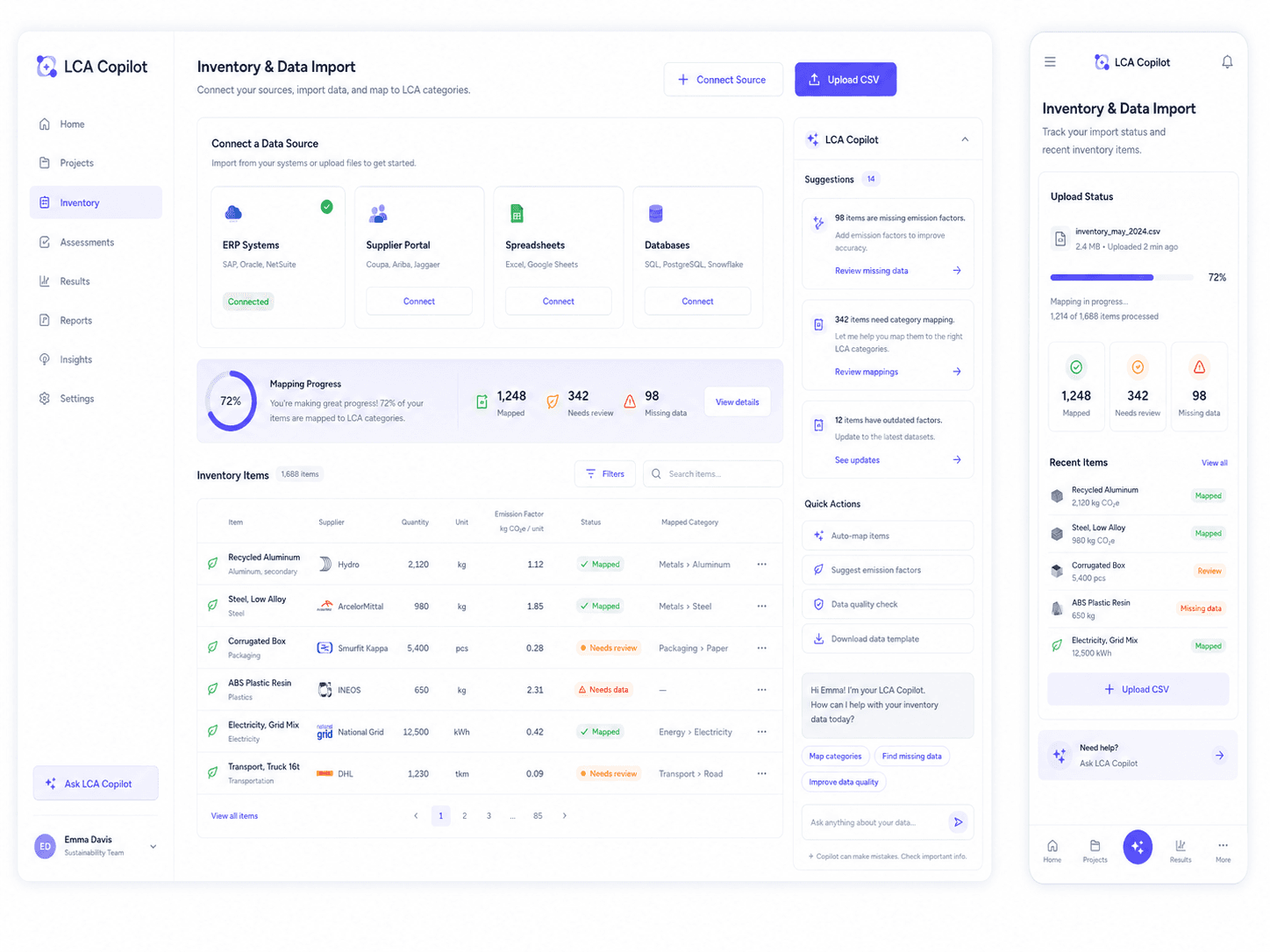
Connect sources, map inventory records, and review data quality.
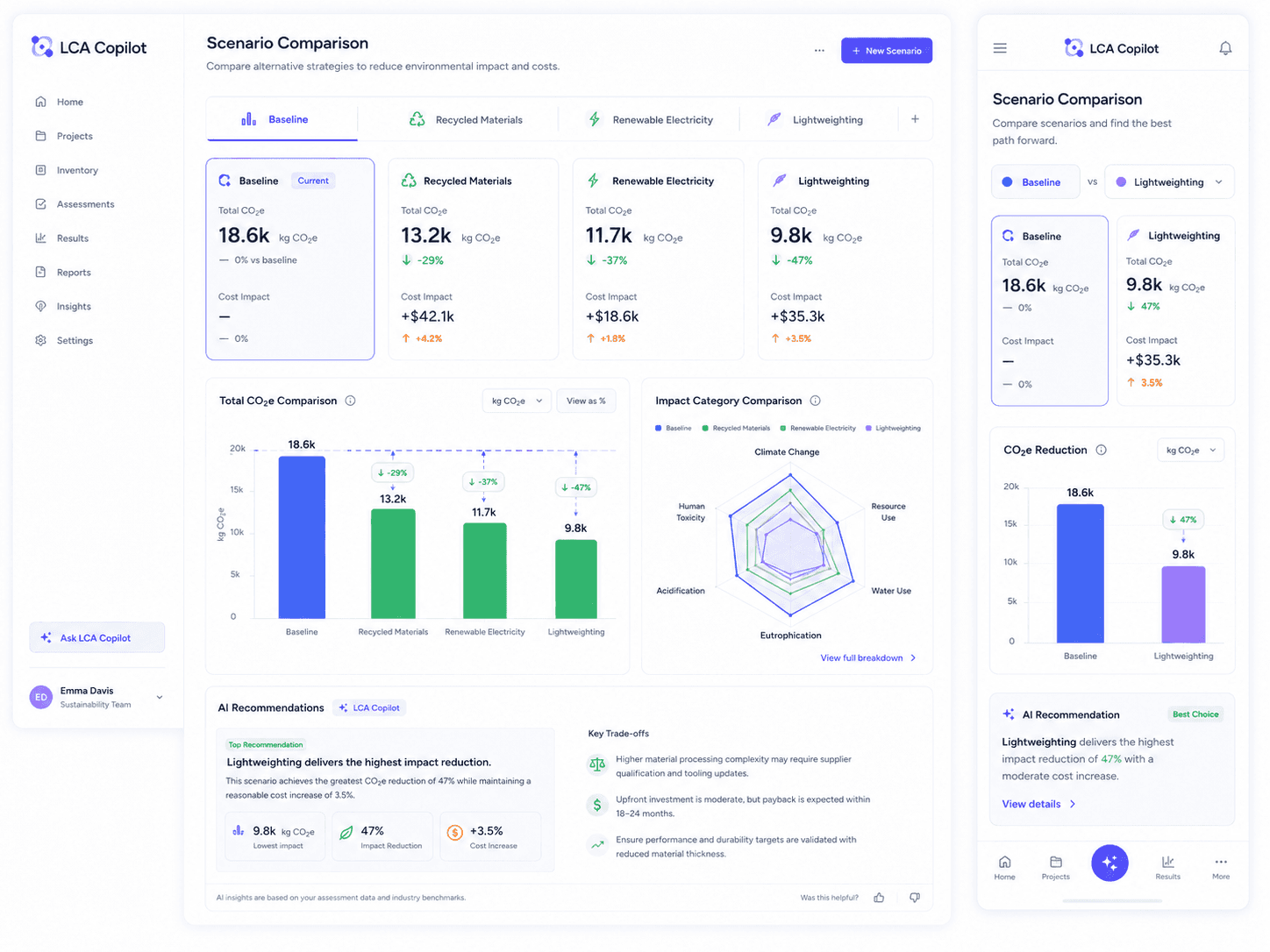
Compare alternatives while keeping assumptions and methods visible.
Interface concepts. Labels and details may change during development.
Features
Core functions in the current product direction.
Define functional units, system boundaries, and cut-off rules through a guided structure that stays attached to the study.
Import, map, and validate inventory data with built-in quality checks and full version history.
Run assessments across multiple LCIA methods and review results through interactive visualisations.
Configure agents to prepare data, run checks, execute approved calculations, and document repeatable work.
Compare alternatives and assumption sets side by side to evaluate design and sourcing decisions.
Generate reports that carry their assumptions with them, and share workspaces across a team.
Integrations
LCAgo orchestrates openLCA, Brightway2, Python, and internal data through a configurable agentic workspace. The scientific tools, methods, and calculation records remain visible and reviewable.
Connects with
 openLCA
 Brightway2
How it works
A configurable, human-reviewed workflow from connected data to traceable results.
Bring in inventory data from databases, files, APIs, and internal systems.
Define goal, scope, functional unit, methods, and review gates.
Run approved work across openLCA, Brightway2, Python, and connected services.
Review data quality, methods, uncertainty, hotspots, and agent actions.
Produce traceable results, scenarios, and reports for decision-makers.
Status
LCAgo combines configurable agents with human-in-the-loop collaboration and expert review. Practitioners define methods, approve actions, review assumptions, and own interpretation; agents assist with data preparation, checks, calculations, and documentation.
Also from SDAI
An AI-native process simulation environment.
Tell us what you are modeling and which tools you use.