

LCAgo
An agentic environment for life cycle assessment.
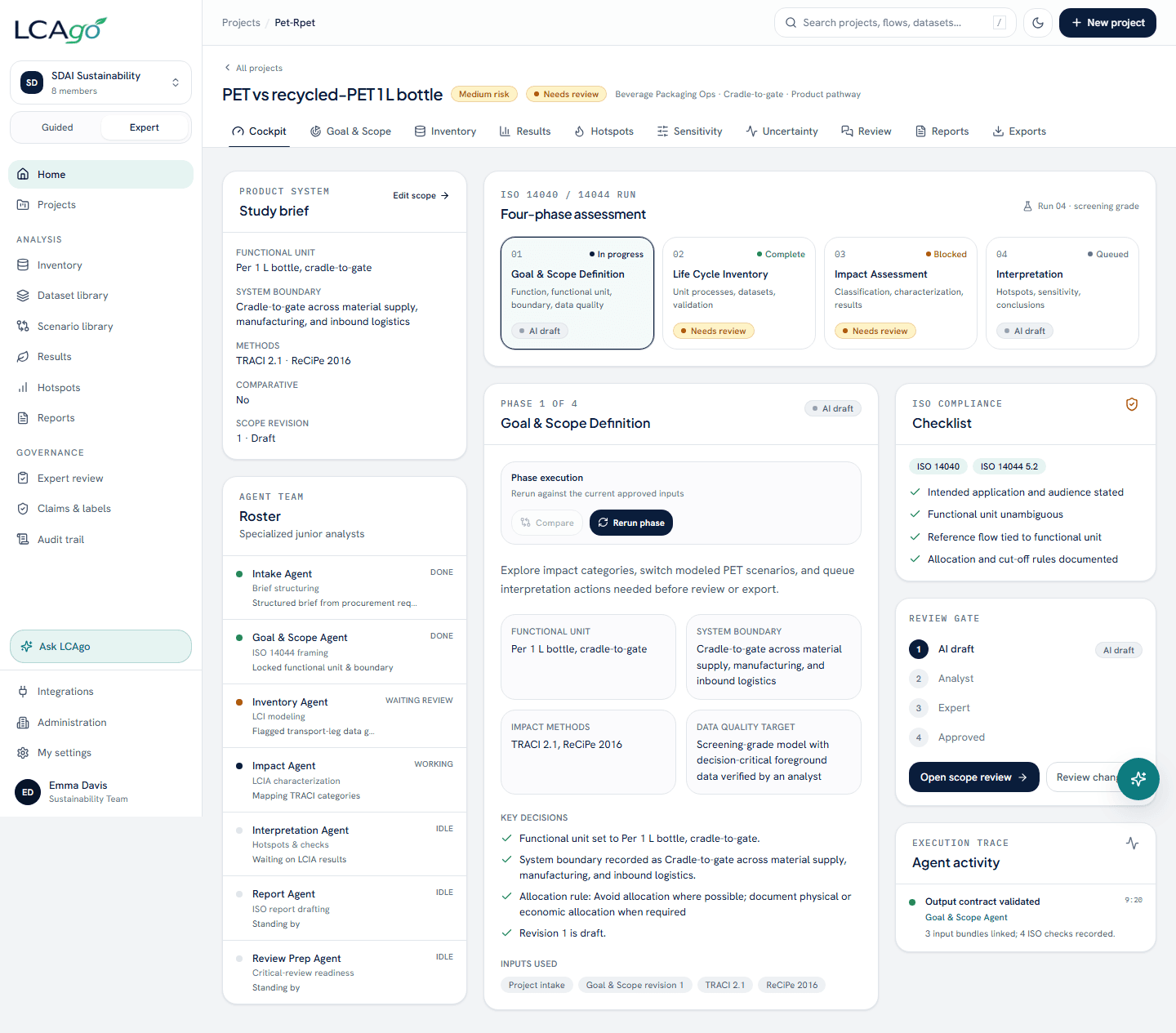
- Goal and scope workflows
- Inventory and data quality management
- Impact assessment across multiple methods
- Scenario and sensitivity analysis
SDAI synchronizes process simulation, techno-economic analysis, and life cycle assessment so teams can evaluate routes and scale-up decisions from one engineering source of truth.
Connects with established engineering ecosystems
 openLCA
 Brightway
 BioSTEAM
Focus areas
The core parts of a process-development study.
Flowsheets, mass and energy balances, and scale-up scenarios.
Capital, operating cost, cash flow, and sensitivity analysis.
Inventory, impact assessment, data quality, and interpretation.
Compare routes, assumptions, and trade-offs side by side.
Connectors for openLCA, Brightway, BioSTEAM, Python, and MCP.
Platforms
BioFlow Studio and LCAgo connect process, economic, and environmental models without locking teams into one simulation stack.
An agentic environment for life cycle assessment.
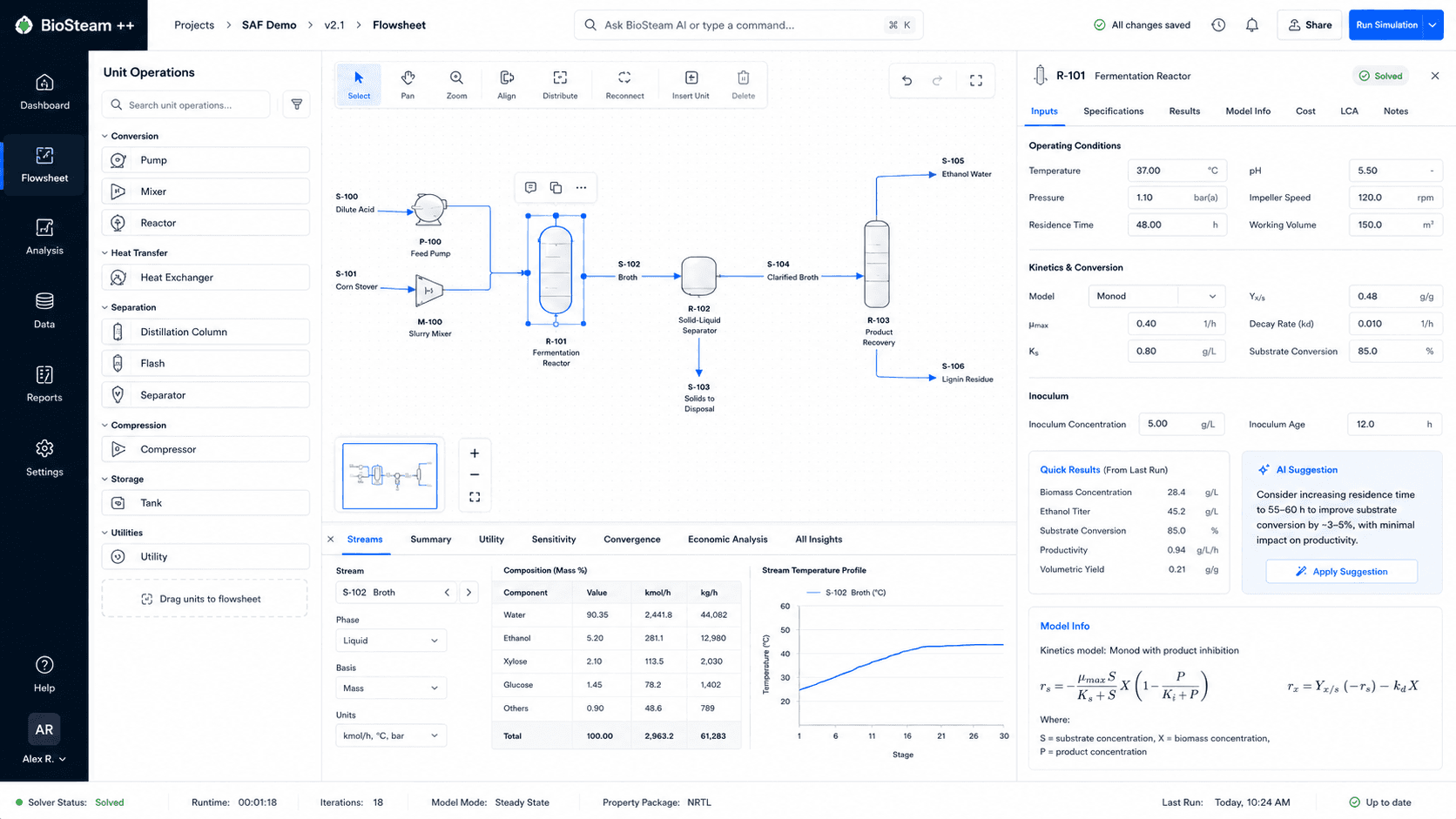
An AI-native process simulation environment.
Use open standards and established scientific software where possible.
Connect process, economic, and environmental tools without hiding them.
Keep assumptions, versions, and results with the analysis.
Keep environmental results connected to the process model.
Open source
Python toolkits and MCP servers for openLCA, Brightway, and BioSTEAM.
 Available
Portable Agent Skills and runtime adapters for rigorous, reproducible life cycle assessment workflows.
AvailablePython toolkit for openLCA calculations, parameter updates, scenario runs, and result extraction.
AvailableMCP server for openLCA search, models, calculations, results, scenarios, and exports.
AvailableMCP server for Brightway 2.5 projects, databases, LCIA, uncertainty, and contribution analysis.
AvailableMCP server for BioSTEAM and QSDsan process models, TEA, foreground impacts, uncertainty, and optimization.
AvailableMCP server for municipal-solid-waste LCA, Monte Carlo uncertainty, scenarios, optimization, and mass-flow analysis.
Tell us what you model and where the handoffs break.
